

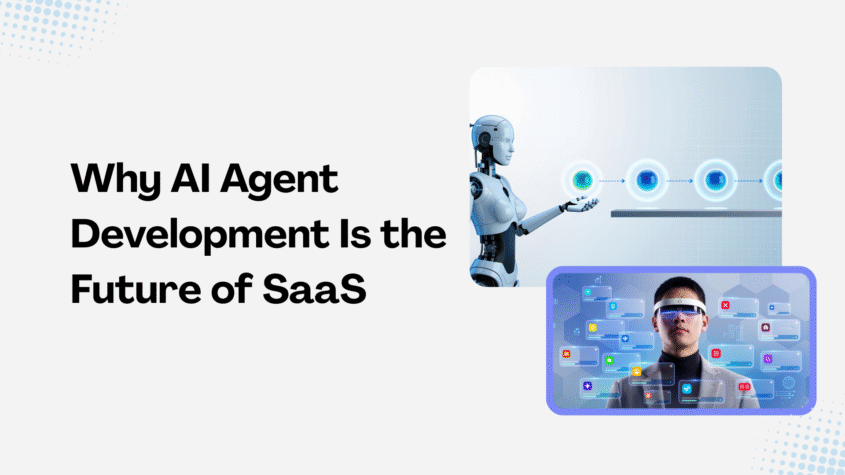
SaaS has always been about efficiency at scale. Deliver software once, serve many, iterate fast, and lower the barrier to adoption. For a long time, that formula worked almost perfectly. Features expanded, interfaces improved, integrations multiplied, and pricing models matured.
Yet something subtle has changed. Customers no longer judge SaaS products only by what they can do. They judge them by how intelligently they behave.
This is where AI agent development enters the picture. Not as a feature enhancement or a premium add-on, but as a foundational shift in what SaaS products are expected to be. The future of SaaS is not just cloud-based software. It is software that understands, decides, and acts.
Let us look at why this shift is happening now, why it matters, and why AI agents are quickly becoming central to the next generation of SaaS platforms.
The SaaS Model Is Reaching a Maturity Ceiling
Most SaaS categories today are crowded. CRM, HR tech, finance tools, marketing platforms, collaboration software. Feature parity is common. Pricing pressure is constant. Switching costs are lower than vendors would like to admit.
In this environment, incremental improvements struggle to stand out. Another dashboard. Another integration. Another workflow template.
Buyers have become more discerning. They want outcomes, not options. They want fewer clicks, not more configuration. They want software that helps them think, not software that demands attention.
AI agent development responds directly to this saturation. It gives SaaS products a way to differentiate through intelligence rather than interface.
SaaS Users Are Overloaded, Not Underpowered
The typical SaaS user today is surrounded by tools. Each tool promises productivity, yet collectively they create friction.
Notifications compete for attention. Dashboards demand interpretation. Reports require follow-up. Users spend significant time managing software instead of benefiting from it.
This is not a usability problem alone. It is a cognitive load problem.
AI agents change the relationship between users and SaaS platforms. Instead of requiring constant interaction, agents monitor, interpret, and act quietly in the background. They surface insights when needed and take routine actions autonomously.
The future of SaaS belongs to products that reduce noise rather than add to it.
From Configurable Software to Adaptive Software
Traditional SaaS products rely heavily on configuration. Users define rules, workflows, triggers, and conditions. This approach offers flexibility, but it also transfers complexity to the user.
AI agent development shifts the burden back to the software.
Instead of asking users to define every scenario, SaaS platforms define goals, constraints, and priorities. Agents handle variation dynamically.
This transforms SaaS from configurable software into adaptive software. The system learns from behavior, adjusts to context, and improves over time.
Adaptability is not a luxury anymore. It is a baseline expectation.
Why Static Workflows No Longer Fit Modern SaaS
Workflows were once the hallmark of mature SaaS products. They brought structure and predictability.
Today, workflows often feel brittle. They assume stable conditions in environments that are anything but stable.
AI agents introduce fluidity. They decide when a workflow applies and when it should be adjusted. They recognize exceptions and respond accordingly.
For SaaS vendors, this means fewer support tickets related to broken automations and more satisfied customers who feel the software understands their reality.
Static workflows belong to the past. Intelligent orchestration defines the future.
AI Agents as Embedded Product Intelligence
One of the most important shifts AI agents bring to SaaS is embedded intelligence.
Instead of analytics living in separate dashboards, agents interpret data continuously. Instead of alerts firing based on fixed thresholds, agents evaluate relevance.
A SaaS product with agents does not wait to be asked questions. It anticipates them.
This proactive behavior changes how value is delivered. Customers stop thinking about how to use the software and start relying on it.
That reliance is the strongest form of product loyalty.
Multi-Tenant Complexity Demands Smarter Systems
SaaS platforms serve diverse customers on shared infrastructure. Each customer has different goals, data patterns, and risk tolerance.
Rule-based systems struggle in this environment. What works for one tenant may fail for another.
AI agents handle this complexity more gracefully. They adapt behavior per tenant without requiring bespoke logic for each one. They learn patterns within boundaries defined by the platform.
This allows SaaS vendors to scale personalization without fragmenting their codebase.
Personalized intelligence at scale is one of the strongest arguments for agent-driven SaaS.
Faster Time to Value for Customers
One of the persistent challenges in SaaS is onboarding. Customers buy powerful tools but struggle to realize value quickly.
AI agents shorten this gap. They guide users, suggest actions, and automate setup based on observed behavior.
Instead of training users to master the product, the product learns how users operate.
This accelerates adoption and reduces churn. In competitive SaaS markets, speed to value often determines survival.
AI Agents Change the Economics of SaaS Support
Support costs scale with customer complexity. As SaaS products grow more powerful, support demands increase.
AI agents absorb a significant portion of this load. They handle common issues, diagnose problems, and recommend solutions with context.
More importantly, they prevent issues by detecting patterns early.
For SaaS businesses, this shifts support from reactive firefighting to proactive care. Costs stabilize. Customer satisfaction improves.
The economics favor intelligence.
Trust, Control, and SaaS Responsibility
SaaS platforms operate at the core of customer operations. Trust is essential.
Modern AI agent development emphasizes governance. Agents operate within permissions. Actions are logged. Decisions are explainable.
This aligns well with enterprise SaaS requirements around compliance, security, and auditability.
Customers want intelligent software, but they also want visibility and control. Agent-driven SaaS platforms that respect this balance gain credibility faster.
Trust accelerates adoption.
AI Agents as a New SaaS Interface
Interfaces shape how users think about software. Menus and forms trained users to navigate. Dashboards trained them to analyze.
AI agents introduce a conversational and contextual interface layer. Users express intent. The system responds with actions or insights.
This does not eliminate traditional interfaces. It complements them.
The result is software that feels more like a collaborator than a tool.
This shift will define the next era of SaaS user experience.
Competitive Moats Are Moving From Features to Intelligence
Features can be copied. Integrations can be replicated. Pricing can be undercut.
Intelligence is harder to duplicate, especially when it is deeply embedded and continuously learning.
AI agents allow SaaS companies to encode domain expertise directly into product behavior. Over time, this creates a compounding advantage.
The future SaaS leaders will be those whose products think better, not just look better.
Why Agent Development Aligns With SaaS Scale
SaaS businesses are built on scale. Agent-based systems scale naturally.
As usage increases, agents learn more patterns. As data grows, insights improve. As customers diversify, adaptability strengthens.
This positive feedback loop aligns perfectly with the SaaS growth model.
Agent development is not an add-on strategy. It is structurally compatible with SaaS economics.
Preparing SaaS Platforms for What Comes Next
Markets are volatile. Customer expectations evolve quickly. Regulatory landscapes shift.
SaaS platforms that rely on static logic struggle to keep up. Those built around adaptive agents respond faster.
The future will favor platforms that can adjust without constant reengineering.
AI agents provide that flexibility.
Conclusion
AI agent development represents a fundamental evolution in how SaaS products deliver value. It transforms software from a passive service into an active participant in customer success. As competition intensifies and users demand more intelligence with less effort, agent-driven SaaS platforms will set the standard. Choosing the right partner is critical, and working with the best AI agent development company can shape whether this future becomes a sustained advantage or a missed opportunity.
What Makes a Good IVF Clinic in Bangalore? Key Factors to Know
Choosing the right IVF clinic is one of the most important decisions for couples strugglin…

Why ABQ Realtors Are Seeing High Demand in the Metro Area
The Albuquerque metro area has experienced a noticeable surge in housing activity over the …