

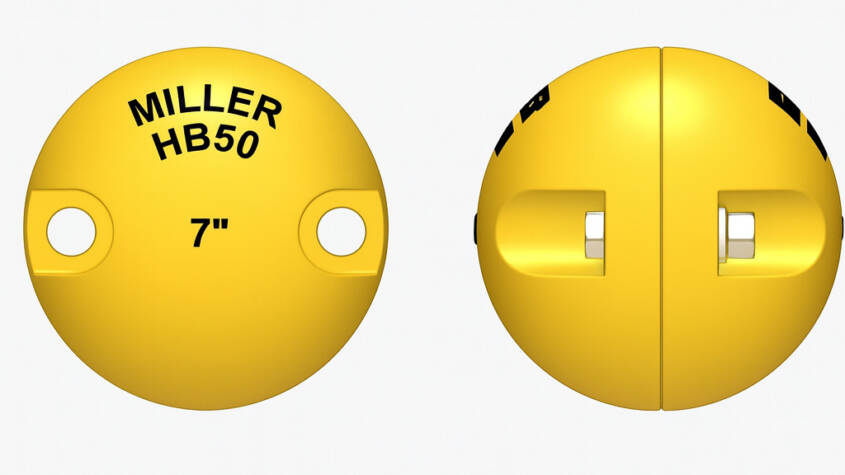
Vertical lifting relies on precision. Every movement of the load, hook, and line affects stability, mainly when cranes operate at height or in windy environments. A crane ball—often referred to as a headache ball—adds weight to the hoist line, helping crews maintain steady hook control.
Without this stabilizing force, hooks twist, cables rotate, and loads drift out of alignment. These issues increase the risk of collisions, snagging, or uncontrolled movement. Introducing a crane ball and hook assembly creates predictable downward tension, giving operators the control needed for accurate lifts and safer jobsite operation.
Tension, Swing Reduction, and Cable Alignment
A headache ball crane system does far more than just add mass. Its design improves multiple aspects of line performance.
An appropriately sized crane ball:
- Increases downward tension to keep the line taut
- Minimizes hook spin caused by cable rotation
- Reduces pendulum swing when the boom or trolley stops
- Improves tracking, making the hook follow the operator’s command more directly
These benefits matter in all lifts but become especially important when working near structures, transferring loads to platforms, or performing repetitive lifts where consistency is essential.
When the ball stabilizes the cable, operators gain a more predictable response from hoist movements, reducing manual corrections and lowering fatigue during extended operations.
Choosing the Right Weight
Crane balls come in different weights to match specific line sizes, crane capacities, and lift profiles. Choosing the right size ensures both stability and safety.
Key considerations include:
- Cable diameter: The ball must match the rope size and fitting.
- Load type: Heavy or wind-sensitive loads may require higher tension.
- Operational height: Long vertical drops benefit from heavier balls to maintain line tightness.
- Crane class: Mobile, tower, and fixed cranes may require different configurations.
Selecting a ball that is too light reduces the stabilizing effect, while a ball that is too heavy can strain the hoist mechanism. The goal is balanced tension—enough weight to maintain control without exceeding equipment limits.
Applications in Telecom, Towers, and Marine Lifting
Crane balls are widely used across industries where vertical precision is non-negotiable.
Common field applications include:
- Telecom tower installation: Minimizes hook rotation in windy, high-elevation conditions.
- Utility pole work: Helps maintain a steady hook when placing transformers or assemblies.
- Marine lifts: Counteract the constant motion caused by waves and vessel sway.
- Construction sites: Improves control for repetitive lifts of materials or tools.
Across these environments, a crane ball helps crews maintain accuracy while protecting both structures and load components.
Safety Checks Before Each Use
Even simple components require routine inspection. Crane balls operate under constant tension and must remain in excellent condition to perform safely.
Best practices include:
- Inspect swivel mechanisms and connection points for wear
- Check the ball housing for cracks or deformation
- Ensure proper securing of the hook assembly
- Confirm compatibility between the ball, line, and hook
- Review manufacturer load ratings before every operation
Operators should also monitor environmental conditions. Strong winds, tight clearances, and uneven ground can magnify load swing, making a stable crane ball even more essential.
Stable Hooks Mean Safer Lifts
Every vertical lift depends on predictable load behavior. A properly selected and well-maintained crane ball improves tension, reduces swing, and keeps hooks stable from ground level to full boom height. These benefits translate directly into safer, more controlled operations across telecom, construction, marine, and utility work.
For rugged, field-tested crane ball and hook assemblies, explore Murphy Industrial Products, Inc., and equip your lifting systems with hardware designed for confidence on every lift.
What Makes a Good IVF Clinic in Bangalore? Key Factors to Know
Choosing the right IVF clinic is one of the most important decisions for couples strugglin…

Why ABQ Realtors Are Seeing High Demand in the Metro Area
The Albuquerque metro area has experienced a noticeable surge in housing activity over the …